Breeding

Clear guidelines for a strong future

Breeding comes with great responsibility. The WHBSF lays down frameworks that guarantee quality standards, strengthen breeding organisations and ensure the long-term preservation of the breed's genetic diversity.

Breeding – Clear guidelines for a strong future

5 Säulen der Zucht

Health
Diversity
Character
Performance
Conformation
Basic principles of the breed
01

Basic principles of the breed

Basic principles of the breed, organisations with original stud books, affiliate stud books

In line with the international agreement reached following the foundation of the WHBSF on 01 February 2013, the historically grown studbook organisations Haflinger Pferdezuchtverband Tirol (HPT or Haflinger Breeders' Association Tyrol) and Associazione Nazionale Allevatori Cavalli di Razza Haflinger in Italia (ANACRHAI or Italian National Association of Haflinger Horse Breeders) are considered the reference organisations for all individual affiliate stud books.
To the principles of the Haflinger breed

Breeding aims
02

Breeding aims

WHBSF statutes, bloodlines, original Haflingers

It is the WHBSF's aim to breed reliable and versatile horses for equestrian sports and leisure activities. The designation "Haflinger" is reserved for horses descending from the seven stallions which are considered the founders of the blood line in Haflinger breeding and from original Haflinger mares; their maximum level of Arab blood may not exceed 1.56%. Genetic material from other breeds is not admissible. The breeding aims are defined in the basic principles of the breed.

Guidelines and legislation
03

Guidelines and legislation

Overarching regulations governing breeding, husbandry and registration

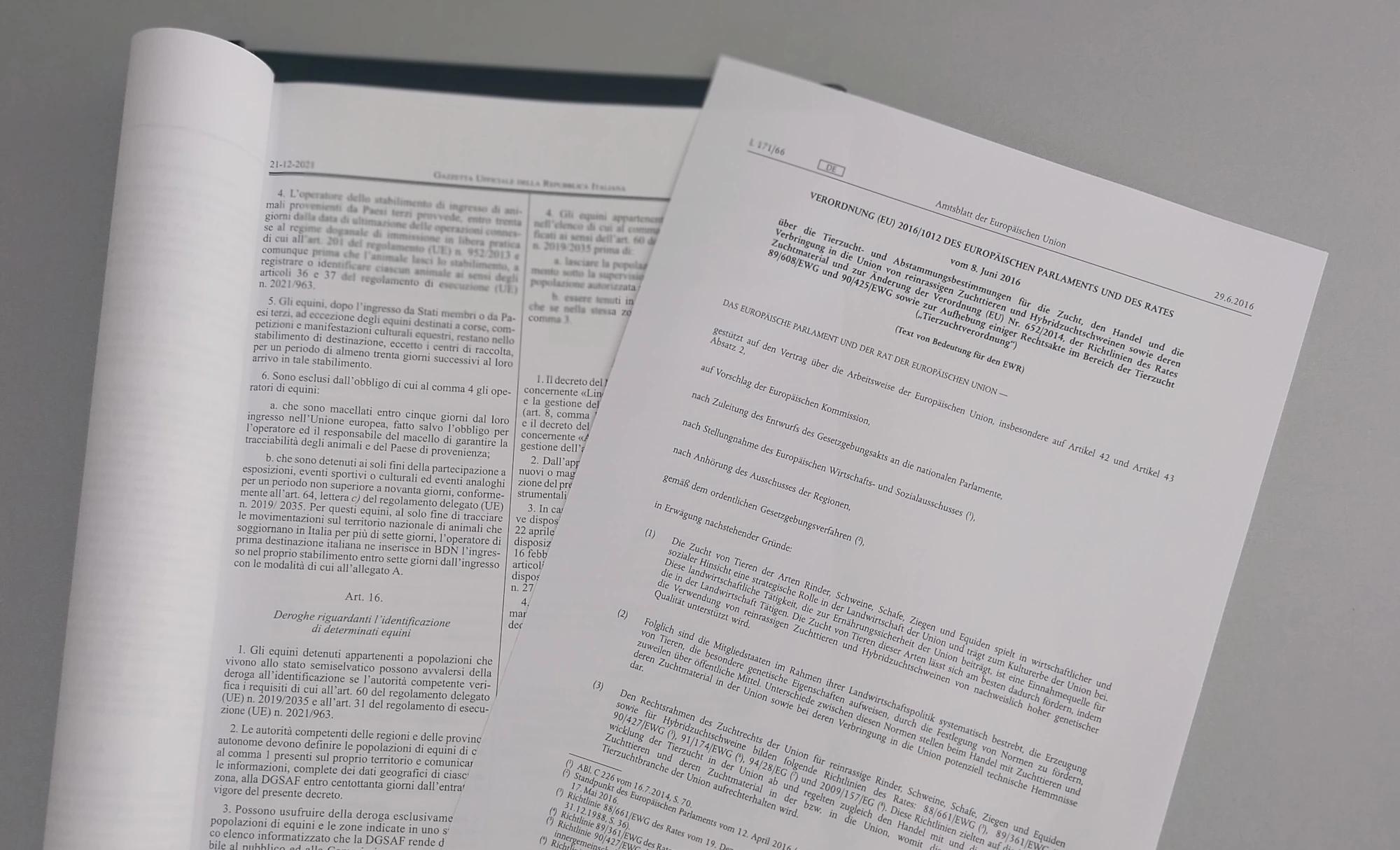
In Europe, the European Union Animal Breeding Regulation 2016/1012 provides a uniform, binding legal framework for horse breeding across the EU – with direct, far-reaching effects on Haflinger breeding. It sets out how breeding associations are recognised, how breeding programmes are approved, how studbooks must be managed and what requirements apply to pedigree, identification, performance testing and breeding value assessment.

National breeding programmes
04

National breeding programmes

Breeding programmes, authorities and scope

EU member states implement the Animal Breeding Regulation within the framework of their national animal breeding legislation. All breeding programmes must be approved by the respective competent authority and must include details on breeding aims, a description of the breed, selection criteria, performance testing, breeding value assessment and geographical scope.

Studbook management, standards, studbook registration
05

Studbook management, standards, studbook registration

Studbook management, standards, studbook registration

The EU Regulation defines minimum standards that are then specified at national level:

  • requirements for registration
  • verification of pedigree
  • identification (equine passport)
  • breeding certification
Harmonisation within the WHBSF
06

Harmonisation within the WHBSF

Basic principles, original stud books, affiliate stud books

The basic principles for the Haflinger breed are established by the organisations in charge of the original stud books and made available to all organisations with an affiliate stud book.

This way, the WHBSF ensures harmonised breeding programmes as well as comparable performance tests and evaluations. In addition, it facilitates the exchange of stud animals and breeding material, all the while providing clear rules for international cooperation.

Databases
07

Databases

Equidae databases, traceability, animal health, UELN numbers

All EU member states are required to maintain centralised databases on equines. They are typically managed by the respective veterinary or agricultural authorities, and data is largely provided by breeding associations or organisations issuing horse passports. The aim is to ensure uniform identification, EU-wide traceability of pedigree and legally compliant registration in stud books. In the USA and Australia, by contrast, there are no central equine databases.

Horses are identified internationally via the UELN (Universal Equine Life Number), their globally unique, lifelong identification number.